
Mighty Mule Gate Repair in Montecito Heights: A Homeowner’s Guide
Mighty Mule gate repair in Montecito Heights usually comes down to one of three failures: a dead 12V battery, a drifted limit switch, or a solar panel that’s angled wrong for the hillside sun. Most of these are fixable in a single visit by a technician who actually works on the brand. If you’d rather not troubleshoot it yourself, call (866) 569-5320 and we’ll send a dedicated gate technician to your property.
Here’s the thing about Mighty Mule openers that catches most Montecito Heights homeowners off guard: they’re sold as a DIY-friendly system, and they are. You can buy one at a farm supply store, unbox it on a Saturday, and have a swinging gate operating by Sunday afternoon. But that same accessibility means these units get installed with small mistakes that quietly compound. A battery that’s the wrong amp-hour rating. A solar panel mounted at an angle that works in June but starves the system by December. A limit switch that’s set “close enough” and drifts further every week until the gate starts slamming or stopping mid-cycle.
We’re Lighthouse Gate Repair home specialists, and Mighty Mule is one of the nine gate brands we service regularly. This guide walks through what actually goes wrong with these openers in this specific neighborhood, how to tell if the repair is worth it, and what questions to ask any technician before you pay for a diagnostic.
Why Mighty Mule Is Everywhere in Montecito Heights (and Why That’s a Double-Edged Sword)
Montecito Heights sits on the eastern edge of the Arroyo Seco, where driveways climb. A lot of properties have gates that swing across a steep approach, and a lot of homeowners looked at gate automation quotes and decided the Mighty Mule price point made sense. And on paper, it does. The linear actuator arm bolts onto the gate, the control board mounts in a weather-resistant box, and the whole thing runs off a 12-volt battery that a solar panel or trickle charger keeps topped up.
But the residential-grade components have limits that the box doesn’t advertise. The actuators are strong enough for a gate that’s balanced and swinging freely. When a Montecito Heights gate picks up binding from a settling post or hinge wear, the motor strains harder on every cycle. That strain pulls more current from the battery. The solar panel can’t keep up when the days get shorter and the panel angle isn’t adjusted for the lower winter sun. The result is a gate that works fine for six months and then slowly dies.
We see this pattern repeatedly: a Mighty Mule opener installed in spring, running strong through summer, then failing in late fall. The homeowner assumes the opener is broken. Most of the time, it’s not the motor at all. It’s the power system running dry because the installation never accounted for the seasonal shift in sunlight that this hillside neighborhood gets.
The Most Common Mighty Mule Failure Modes We See in Montecito Heights
When we get a call for a dead or erratic Mighty Mule opener in Montecito Heights, the diagnosis usually lands in one of four categories. Here’s what actually happens on the ground, in order of frequency:
1. Battery Drain from Hillside Temperature Swings
Mighty Mule systems run on sealed lead-acid or lithium batteries, usually 12V. The manufacturer specifies a battery with enough amp-hour capacity to run a certain number of cycles per day. That spec assumes moderate temperatures. Montecito Heights gets hot afternoons on exposed slopes and cold nights in the canyon. Those swings shorten lead-acid battery life considerably. A battery rated for three years might deliver eighteen months here. When the battery weakens, the opener still tries to run, but the voltage drops under load and the gate stalls mid-cycle or stops responding entirely.
2. Solar Panel Angle Errors
The stock Mighty Mule solar panel is 10 watts, which is enough when it’s aimed directly at the sun. Most DIY installs set the panel flat or vertical against a fence post. In summer that’s tolerable. In winter, the sun sits lower over the San Gabriel foothills and a misaligned panel can lose 60% of its output. The battery never fully recharges, and within weeks the system is dead. The fix is often as simple as adjusting the panel angle, but you need a technician who checks panel output with a meter rather than assuming the panel works because it’s new.
3. Limit Switch Drift
The Mighty Mule control board uses limit settings to tell the actuator when to stop pushing. These settings are adjusted with potentiometers or DIP switches depending on the model year. Over time, and especially with temperature changes, the internal reference drifts. The gate starts opening too far or not far enough. It slams into the stop post, or it stops a foot short and the homeowner has to squeeze through. Drift isn’t a component failure. It’s an adjustment issue that requires popping the control box and recalibrating. But if a technician resets it without checking why it drifted, the problem comes back.
4. Actuator Wear on Steep-Grade Gates
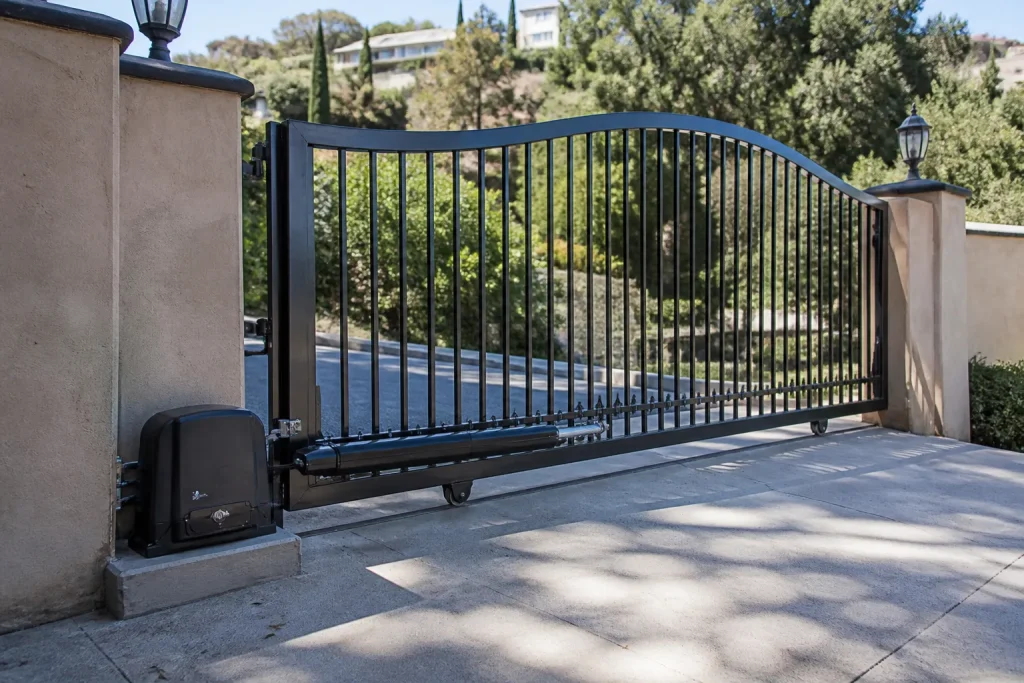
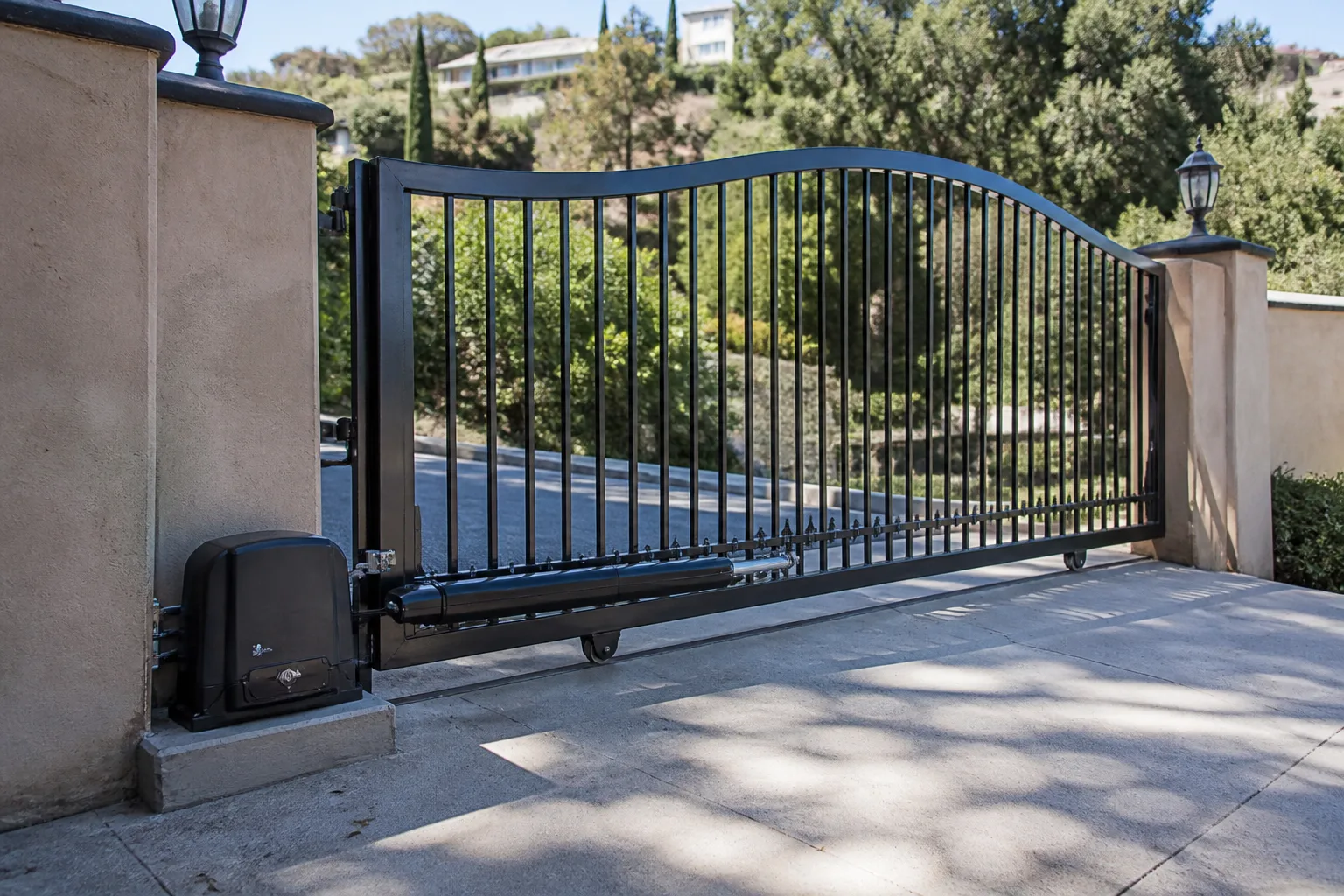
The linear actuator is the metal arm that physically pushes and pulls the gate. On a level driveway with a balanced gate, a Mighty Mule actuator can run for years. On a Montecito Heights driveway with a slope, the gate’s weight shifts through the swing arc, and the actuator absorbs more stress. We see actuator gears strip and internal limit switches fail far earlier on hillside installs than on flatland ones. This is the one failure that’s genuinely mechanical and often pushes homeowners toward replace-versus-repair territory.
Why Most Gate Companies in LA Won’t Touch a Mighty Mule They Didn’t Sell
This is the part of the story most homeowners don’t know until they’re stranded. Mighty Mule sells through retail channels: farm stores, hardware chains, online marketplaces. The company doesn’t have a dealer network like LiftMaster’s or DoorKing’s. That means most professional gate installers never sold Mighty Mule, never stocked its parts, and never trained their techs on its wiring. When you call one of those companies about a dead Mighty Mule opener in Montecito Heights, the technician arrives, looks at the retail branding, and tells you it’s not worth fixing. Then they quote a full system replacement with whatever brand they carry.
That’s not a repair diagnosis. That’s a sales call.
We take a different approach because our model is brand-agnostic. We don’t make money on which brand we install. We make money on getting your gate back to working order, whether that’s a $40 battery replacement or a full system swap. When a Mighty Mule comes across the bench, we diagnose it the way we’d diagnose a commercial Viking or a Linear: component by component, with a meter and a process, not a preference.
What a Legitimate Mighty Mule Diagnostic Looks Like
If you’re scheduling a repair call for a Mighty Mule in Montecito Heights, here are the questions you should ask the technician before they touch anything. These apply to any brand, but they matter more on a retail system because there’s no dealer support line to back anyone up:
- Will you test the battery under load, or just check voltage? A resting battery can read 12.6 volts and still collapse when the motor draws current. A load test is the only way to know. If the tech doesn’t have a load tester, they’re guessing.
- Will you meter the solar panel output before and after adjusting the angle? The panel needs to produce enough current to recover the battery after each cycle. If the tech eyeballs the angle and moves on, the system will fail again when the season changes.
- Do you recalibrate the limit switches every time, even if that’s not the reported problem? A good Mighty Mule diagnostic includes verifying the stop points because limit drift is often the underlying cause of what looks like a motor problem.
- When you recommend replacement, what’s the specific reason? A legitimate replacement recommendation names the failed component, the part cost, the labor, and the remaining life of the rest of the system. A vague “these aren’t worth fixing” without numbers is a red flag.
We’ve pulled Mighty Mule openers out of garages in Montecito Heights where the “dead” unit just needed a $35 battery and a limit switch reset. We’ve also looked at systems where the actuator was stripped, the board was corroded, and the gate itself needed hinge work before any opener would survive. The diagnostic is what tells you the difference.
The Repair-Versus-Replace Calculus for Mighty Mule Specifically
Here’s the honest math, and it’s different for Mighty Mule than for a commercial-grade system. A Mighty Mule actuator is an entry-level component. The system is designed for a certain number of cycles at a certain load. When the actuator fails, you can replace just that arm. But you’re bolting a new arm onto a board that’s been through the same weather, a battery that’s aging, and a gate that may be heavier or stiffer than it was when the system was installed. Sometimes that makes sense. Sometimes it doesn’t.
As a rough rule: if the failure is in the power system (battery, solar panel, charger) or the limit settings, repair usually wins. Those are wear items and adjustments with a clear remaining life. If the failure is mechanical inside the actuator and the unit is more than a few years old with visible corrosion on the board, replacement starts making more sense, especially on a steep Montecito Heights driveway where the next actuator will face the same stress profile.
When we recommend replacement on a Mighty Mule, we don’t push a specific brand just because it’s on the truck. Some homeowners want another Mighty Mule because it’s what they know and the price is right. Some want to upgrade to a heavier system like a BFT or a Ghost Controls, especially if they’ve added weight to the gate or are tired of the cycling issues. Both paths are legitimate, and the choice depends on how long you plan to stay in the house, how much the gate weighs, and how often it cycles per day.
How Lighthouse Diagnoses a Mighty Mule Without Turning It Into a Sales Pitch
Our business is structured differently from most gate companies in the Los Angeles area. We service nine brands: LiftMaster, FAAC, BFT, Linear, Viking, Ghost Controls, DoorKing, Elite, and Mighty Mule. That’s the whole list. When a technician arrives at a Montecito Heights home with a Mighty Mule opener on the post, there’s no incentive to tell you the brand is junk and you need a new system at three times the price. We work on your brand. Our repair path and our replacement path both keep us employed.
That matters in a neighborhood like Montecito Heights, where the gates are diverse. The same street can have a Mighty Mule on a single swing gate, a Ghost Controls on a dual gate, and a commercial Viking protecting an apartment complex. A generalist who only knows one brand can’t honestly serve that range. We can.
And because we’re a dedicated electric gate repair in Montecito Heights operation, the wiring, control boards, and safety sensors are the core competency. Not a side category. A Mighty Mule diagnosis gets the same process as a commercial access system: load-test the battery, meter the panel, verify all safety inputs, recalibrate limits, and then report what’s actually wrong with a number attached.
One anecdote that stays with us: we got called to a property off Montecito Drive where the homeowner had already paid another company to replace the battery twice in six months. The gate kept dying. When we arrived, the culprit wasn’t the battery at all. The solar panel was mounted on the north side of a fence post, getting maybe two hours of direct sun in midsummer and none by October. Two battery replacements, zero panel checks. Total cost to the homeowner before we arrived: over $400. Actual fix: reposition the panel to the south face and add a charge controller. That’s what a real diagnostic catches.
When to Call a Pro (Before the Gate Stops Working)
Most Montecito Heights homeowners call for gate repair when the gate is already dead. That’s understandable, but there are earlier warnings worth acting on because catching them saves money. If your Mighty Mule opener is cycling slower than it did last year, that’s a battery or power delivery issue that will eventually strand the gate. If the gate pauses halfway and then reverses, that’s a limit or obstruction sensor issue. If you hear a grinding noise from the actuator, stop running the gate immediately and call a gate repair in Montecito Heights specialist before the gears fully strip and the arm seizes.
We also recommend an annual check for any Mighty Mule system in this neighborhood, and we tell people this not to sell service contracts but because the seasonal sun shift here is real. Spending thirty minutes once a year adjusting the panel angle and load-testing the battery prevents most of the emergency calls we answer in the winter months.
Safety note: Mighty Mule systems are low voltage, but that doesn’t make them zero risk. A moving gate can cause serious injury, and the actuator arm is under load even when the system is off. If you’re checking the arm for wear or the hinges for binding, disconnect the battery first and never reach between the gate and the post while the system is powered. Some diagnostics are homeowner-level. Others belong on a technician’s workbench.
If you’re reading this because your Mighty Mule is already dead, here’s the short version: the fix is probably a battery or an adjustment, it’s usually done in one visit, and it costs far less than a new system. Related services in Montecito Heights include gate installation in Montecito Heights if you’re starting from scratch or ready to upgrade.
The Bottom Line
Mighty Mule openers are common in Montecito Heights because they’re affordable and DIY-friendly, but the same accessibility leads to installation errors that compound over time. Battery drain from temperature swings, solar panel angles that work in summer and fail in winter, and limit switch drift are the three most common failures we see. The battery testing and panel metering are what separate a legitimate diagnostic from a guessing game. And the repair-versus-replace decision depends on whether the failure is in the power system or inside the actuator itself.
If you’re in Montecito Heights and dealing with a Mighty Mule gate that won’t open, won’t close, or is acting erratically, Lighthouse Gate Repair offers free estimates with a diagnostic-first process. Call (866) 569-5320 to schedule a visit. We’ll tell you exactly what’s wrong, exactly what it costs to fix, and then you decide. No brand pressure, no upselling, no guesswork.
Frequently Asked Questions
Most Mighty Mule repairs in Montecito Heights fall between $45 and $260, depending on the failed component. A replacement 12V battery typically runs $45 to $90 installed. A solar panel reposition or replacement runs $80 to $150. Limit switch recalibration is usually a service-call minimum. A full actuator replacement can reach $350 to $500 installed. Call (866) 569-5320 for an exact quote, estimates are free.
In most cases, yes. Battery replacements, limit recalibrations, and panel adjustments are all same-visit jobs, assuming the parts are on the truck. If your actuator needs replacement, we may need to order the specific model, which can add a day or two. Call (866) 569-5320 and we’ll tell you what the timeline looks like for your specific issue.
This is almost always a solar charging issue. In Montecito Heights, the winter sun sits lower over the San Gabriels, and a panel that was angled for summer sun loses most of its output. The battery stops recharging fully, then gradually drains until the opener won’t run. The fix is repositioning the panel and verifying the charge rate with a meter. Call (866) 569-5320 for a solar panel assessment.
If the failure is in the battery, solar panel, charger, or limit settings, repair is usually the smarter money. Those are wear items and adjustments with clear remaining life. If the actuator gears are stripped and the board is corroded, replacement starts making sense, especially on a steep driveway where the next actuator will face the same stress. We’ll give you a straight answer with numbers either way. Call (866) 569-5320 for a diagnostic.
Written by the team at Lighthouse Gate Repair, serving Montecito Heights since 2018.
Need Gate Repair Help?
Call Lighthouse Gate Repair - licensed & insured, here with fast help in Montecito Heights.
(866) 569-5320